October 15, 2026
9 min read
by Athlete24AI
Running Form: What to Fix, What to Leave Alone, and How to Get Faster
Most runners worry about their form more than they need to. Watch the front of any big race and you will see elite athletes with odd arm swings, wobbly heads and feet that land in every possible way. They are still fast, because speed comes mostly from fitness, not from looking textbook.
That does not mean form is irrelevant. A couple of habits are worth changing because they take load off your knees and hips, and a few drills help you move more cleanly when you run fast. The rest is mostly noise. This guide covers what to fix, what to leave alone, and what actually makes you faster.
What good running form looks like
Here is one stride, from the moment your foot touches the ground to the moment it leaves, described the way a coach would watch it from the side:
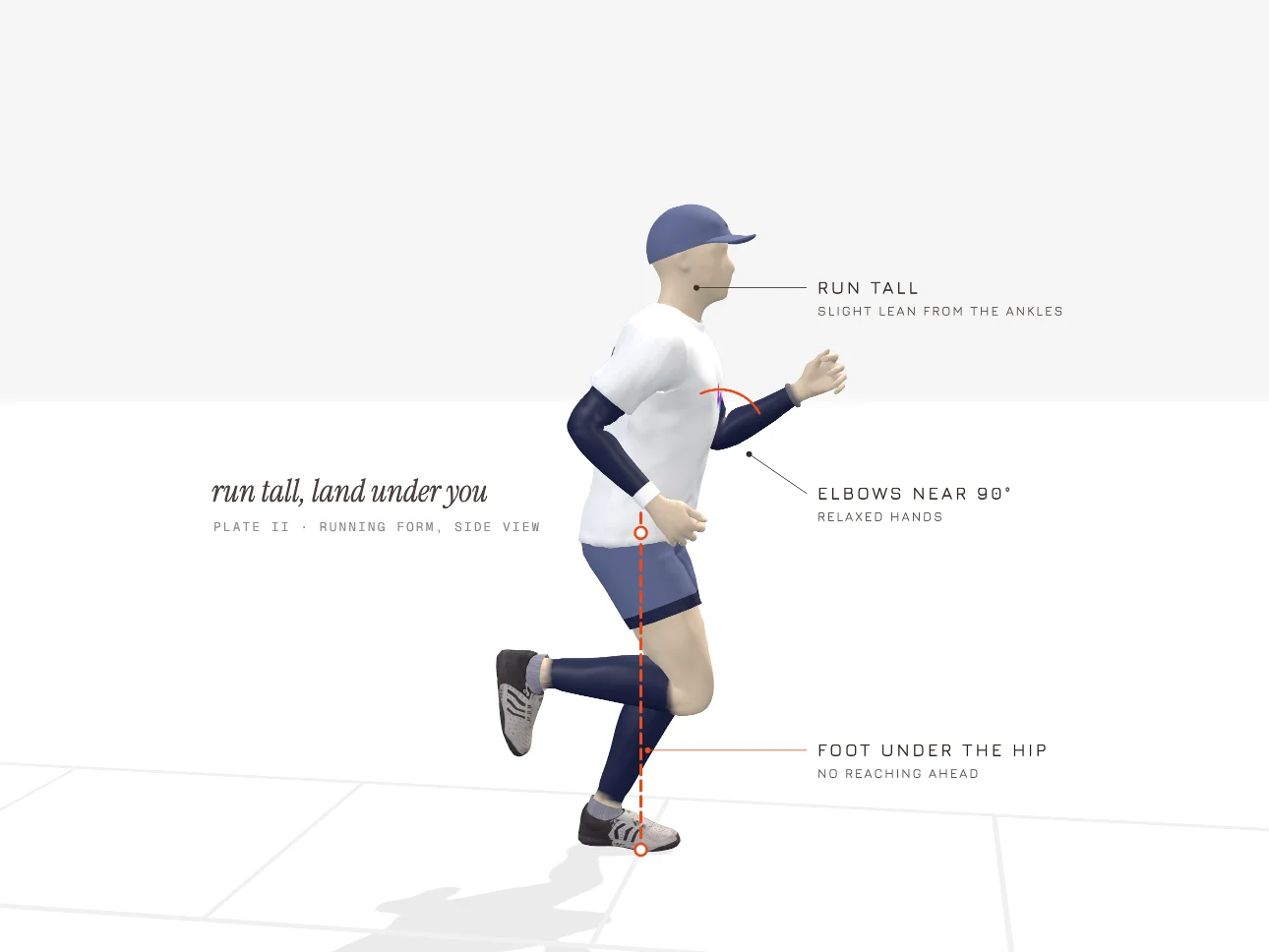
- Head and posture: you run tall, eyes looking ahead rather than down at your feet. There is a slight forward lean, and it comes from the ankles, not from bending at the waist.
- Landing: your foot touches down close to underneath your hips, with the knee slightly bent. It does not reach far out in front of you.
- Stance: the knee bends a little more as your weight comes over the foot. This is your body absorbing the landing, and it should feel springy rather than heavy.
- Push-off: the foot leaves the ground behind you and the heel comes up towards your backside. How high it comes up depends on your speed. Easy running needs very little.
- Arms: elbows bent at roughly 90 degrees, hands relaxed, swinging forward and back rather than across your chest. The arm opposite your front knee comes forward.
- Rhythm: steps feel quick and light rather than long and bouncy.
If you read that list and thought "I already do most of that", you probably do. Most runners settle into a stride length that is close to their most efficient one without being taught.
Your body already does most of the work
Running is something you have practised many thousands of times on every run. Over time your body finds a stride that costs it the least energy at the speeds you usually run, and it does this without you thinking about it.
This is why big, deliberate form overhauls rarely pay off. If you copy a stride you saw in a video, you are swapping a pattern your body chose for one it has never practised. In the short term that usually makes running feel harder, not easier. So the bar for changing something should be high: it needs a clear reason, like pain or an obvious habit that loads your joints more than it should.
There is one habit that meets that bar for a lot of runners.
The one change worth making: overstriding
Overstriding means your foot lands well out in front of your body, with the knee nearly straight. Each step then acts like a small brake, and your knee and hip take the impact instead of your whole leg absorbing it.
The most reliable way to fix it is not to think about your feet at all. Take slightly quicker steps, and your stride shortens on its own.
A well known study by Heiderscheit and colleagues had runners keep the same speed while changing only their step rate. Taking 5 to 10 percent more steps per minute clearly reduced the load on the knee, and at 10 percent the hip as well. Later research has backed this up and it is now one of the most common changes physiotherapists use with injured runners.
How to check and change your cadence:
- On an easy run on flat ground, count every time either foot lands for 30 seconds, then double it. That is your steps per minute.
- Add 5 percent. If you counted 160, your target is about 168.
- Use a metronome app or a watch with a cadence alert set to that number for part of a few easy runs each week. Keep your pace the same; only your steps get quicker.
- After two or three weeks it usually feels normal. If you still overstride, try another 5 percent.
Two honest notes. First, this protects your joints, it does not make you faster on its own. Second, the often quoted target of 180 steps per minute is not a rule. It came from watching elite runners at race pace. Your number depends on your height, your speed and your legs, so only ever compare you with you.
Leave your foot strike alone
You may have read that landing on your forefoot is better than landing on your heel. For most runners, the evidence says otherwise.
A large review by Anderson and colleagues pulled together 53 studies on changing foot strike. Switching from a heel strike to a forefoot strike did not make runners more economical, and in the short term it often made them less economical. It also moved load away from the knee and onto the calf and Achilles. That is a bad trade for anyone who already has sore calves or shins, which we cover in our article on shin splints.
Where your foot lands relative to your body matters far more than which part of the foot touches first. A heel that lands under your hips is fine. A forefoot that lands far out in front is still overstriding. If you fix the overstride with a quicker cadence, your foot strike tends to sort itself out.
Arms, posture and relaxation
These three are less about speed and more about not wasting energy:
- Arms: keep the elbows near 90 degrees and let the swing come from the shoulder. If your hands cross the middle of your body, your shoulders twist and your hips follow.
- Hands: loose, as if you were holding a crisp without breaking it. A clenched fist tends to tighten your forearms, shoulders and neck.
- Shoulders: low and relaxed. When you get tired they creep up towards your ears. A quick shake of the arms on a long run resets them.
- Posture: think tall rather than leaning. If you try to lean forward on purpose, most people bend at the waist, which does the opposite of what you want.
Use these as occasional reminders, not as a checklist to run through on every step. One cue at a time, for a minute or two, is plenty.
Drills that rehearse good form
Running drills break the stride into pieces and exaggerate each one: lifting the knee, landing under the hips, a quick and light contact with the ground. They are best thought of as coordination practice and a warm-up for faster running. There is little direct proof that drills by themselves change how you run, but they are low risk, they wake up the legs before hard sessions, and they make it easier to feel the positions described above.
Do them after 10 minutes of easy running and before strides, intervals or hill repeats. Two or three of them, two sets each, takes less than ten minutes.
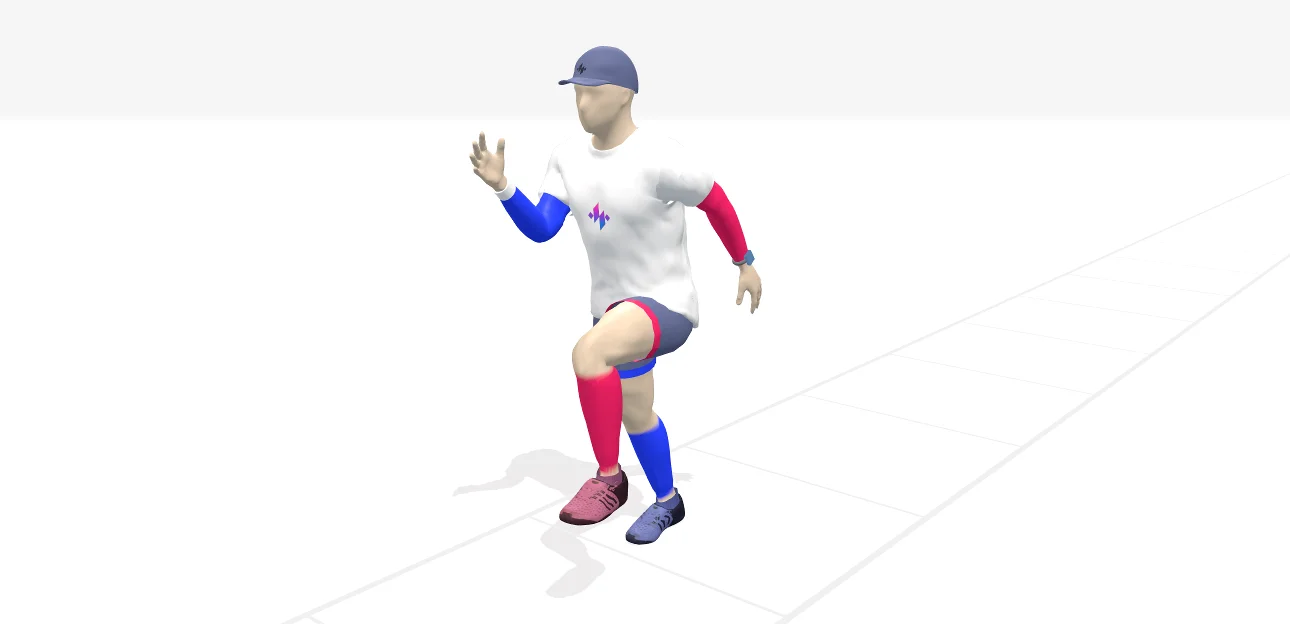
- A-skip, 2 × 20 m: a skip that drives one knee up to hip height and punches the foot back down under the hips. It trains the front of the stride and a light, quick landing.
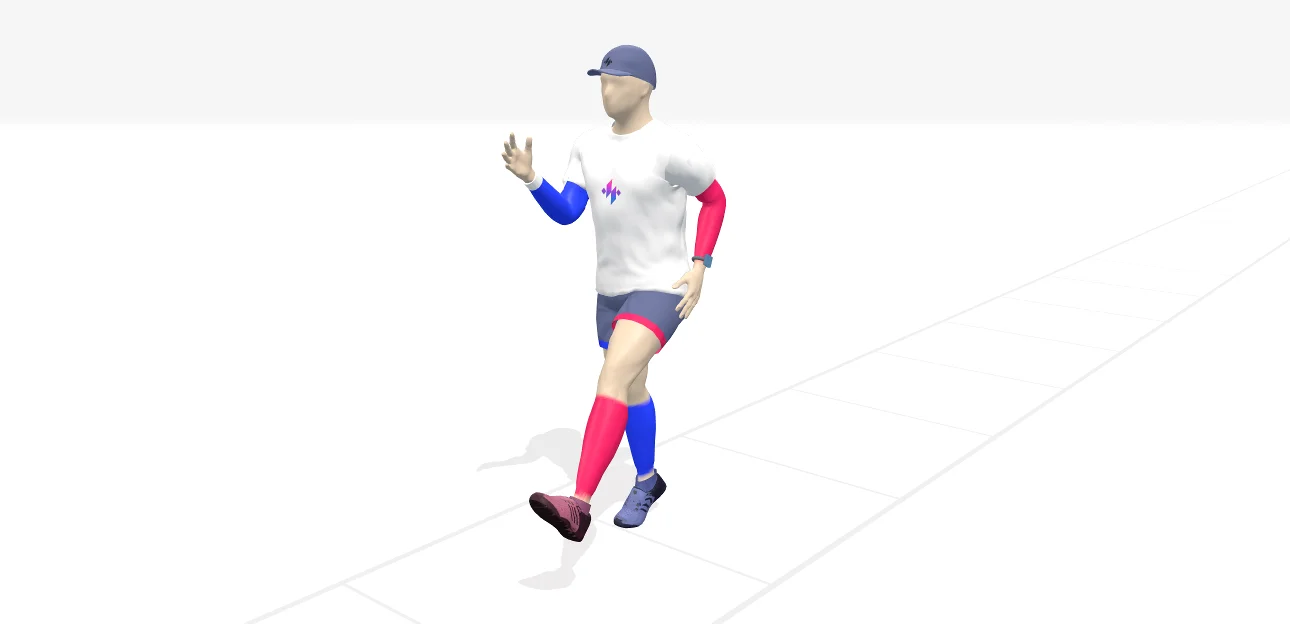
- B-skip, 2 × 20 m: the A-skip with the lower leg unfolding before the foot paws back under the body. It teaches you to land under yourself instead of reaching.
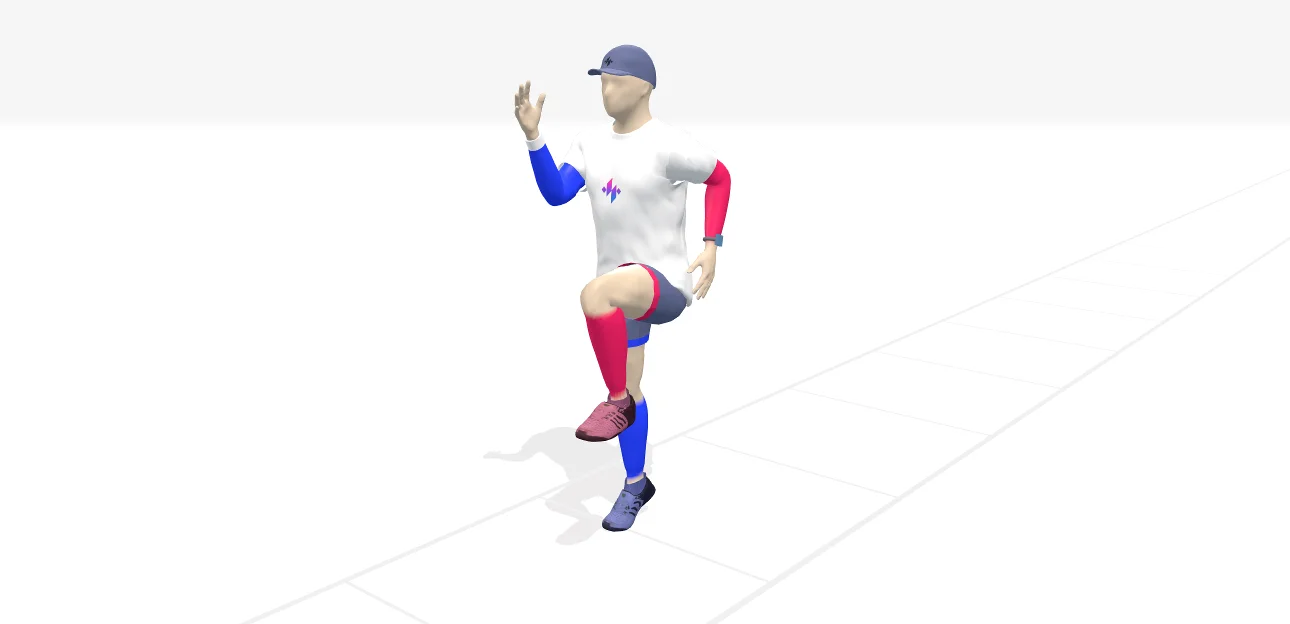
- High knees, 2 × 15 s: a fast run on the spot with the knees coming above the hips. It trains quick, springy ground contacts at full rhythm.
Keep them relaxed and controlled. A drill done fast and sloppy rehearses the wrong thing.
How to actually run faster
Form gets a lot of attention, but most of your speed comes from training. These are the things that make the biggest difference, roughly in order:
- Run consistently. Three or four runs a week, most of them easy, week after week. This builds the engine everything else sits on. If you are not sure what easy means for you, our Running Pace Calculator and the article on pace and speed help you find it.
- Add strides. At the end of one or two easy runs, do 4 to 6 relaxed accelerations of about 20 seconds, walking back between them. They teach you to run fast with good form without the fatigue of a hard workout.
- Do one quality session a week. Intervals or a tempo run. For example, 6 × 2 minutes at about your 5K effort with 2 minutes of easy jogging between them.
- Run hills. Short hill sprints of 8 to 10 seconds, fully recovered between them, build power with less impact than flat sprinting.
- Lift and hop. Two short strength sessions a week, including calf raises and some simple hopping or skipping, make your legs stiffer and springier. Plyometric work like this is one of the few things shown to improve how economically you run.
A simple week for someone running four times:
- Easy run with 6 strides at the end
- Strength session with drills, calf raises and hops
- Interval session, with the drills as part of the warm-up
- Easy run
- Rest
- Long, easy run
- Rest or a short walk
Build it up gradually. Adding more than you are used to in one go is the most common way runners get hurt, and our Running Plan Generator can lay out a progression for your current fitness.
A two-minute form check
You do not need a lab for this. Ask someone to film you from the side for ten seconds while you run at an easy pace on flat ground, then watch it in slow motion and look for three things:
- Where does your foot land? Pause the video at the moment it touches the ground. If it lands well ahead of your hips with a straight knee, try the cadence change above.
- Are you tall? Look for a straight line from ankle to head with a small forward tilt, not a fold at the waist.
- Are your steps light? A lot of up and down bounce, or a loud slap at each landing, usually means long steps. Quicker steps help here too.
Film it again a month later. If those three look reasonable, stop worrying about your form and put the time into the training above. That is where the speed is.
Sources

AI-powered running coach. Personalized training plans, real-time coaching, and smart analytics for runners of all levels.
© 2025 ATHLETE24AI
Resources
Company
Privacy
Terms
Support