October 13, 2026
9 min read
by Athlete24AI
Shin Splints: Why They Happen and How to Get Back to Running
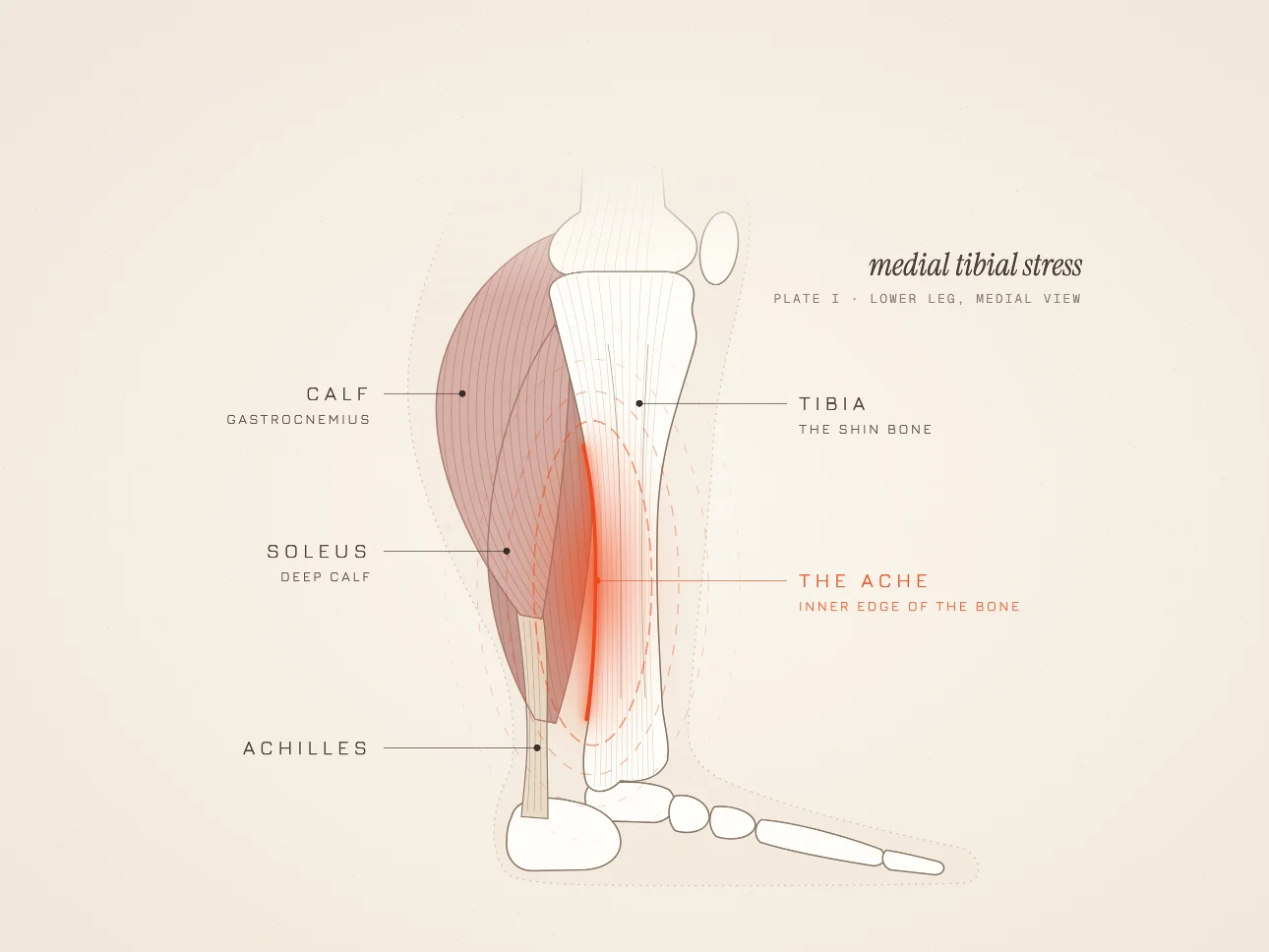
It usually starts as a dull ache along the inside of the shin. It is there for the first ten minutes of a run, fades once you are warm, and comes back that evening or the next morning when you walk down the stairs. If that sounds familiar, you probably have shin splints.
They are one of the most common running injuries. Studies put the share of runners who get them somewhere between 5 and 35 percent, and new runners sit at the top of that range. The good news is that shin splints are very manageable when you catch them early. The bad news is that running through them for weeks can turn a mild problem into a stress fracture.
What shin splints actually are
The medical name is medial tibial stress syndrome, or MTSS. "Medial tibial" means the inner edge of the shin bone (the tibia), and that is where the pain sits: along the lower half to two thirds of the bone, on the inside, usually over a stretch of 5 cm or more.
For a long time shin splints were blamed on inflamed muscles pulling on the bone. The current view is that it is mainly a bone problem. Every time your foot lands, the tibia bends very slightly. Bone responds to that by remodelling and getting stronger, but the process takes weeks. If you add running faster than the bone can adapt, small amounts of damage build up quicker than they are repaired, and the bone and the tissue around it get sore.
That is also why shin splints and stress fractures are related. They sit on the same scale. Shin splints are the early, more forgiving end of it.
Why you got them
The single biggest cause is doing too much, too soon. That might mean starting a running plan from zero, coming back after a few months off, signing up for a race and jumping your long run, or moving from treadmill to pavement.
A large study of more than 5,000 runners using Garmin data, published in the British Journal of Sports Medicine in 2025, looked at this closely. It found that injury risk went up when a single run was longer than the longest run of the previous 30 days. A run 10 to 30 percent longer was linked to about 64 percent higher risk. Doubling it was linked to more than twice the risk. Weekly mileage changes predicted much less. The takeaway is simple: one big jump in a single run matters more than you might think.
Other things that make shin splints more likely, according to the research reviews:
- You have had them before. A previous episode is one of the most consistent risk factors.
- You are new to running. Fewer years of running means bones that have had less time to adapt.
- Higher body weight. More load per step.
- Being female. Several reviews find a higher rate in women.
- Not eating enough for your training. Low energy intake (sports scientists call it RED-S) slows bone repair. If you are training more while also trying to lose weight, this applies to you.
- Foot shape. A larger drop in the arch when you stand (navicular drop) shows up in several studies, though the effect is modest.
You cannot change all of these, but you can change the first one. In most cases shin splints are a training load problem first and everything else second.
Shin splints or a stress fracture?
This is the most important part of the article. The two can feel similar early on, but they are treated very differently.
Signs that point to shin splints:
- The sore area is spread out, roughly the length of your hand or longer
- Pressing along the inner edge of the bone is tender over a wide strip
- It hurts at the start of a run and eases as you warm up
- It settles with rest and is gone or nearly gone the next day
Signs that point to a stress fracture:
- The pain is in one spot you could cover with a fingertip
- It gets worse the longer you run, and may force you to stop
- It aches at rest, when walking, or at night
- Hopping on that leg hurts sharply at that spot
- There may be some swelling over the sore point
If your pain matches the second list, stop running and see a sports doctor or physio. Do not keep hopping on it to check. Repeated testing can make it worse. Also know that an X-ray in the first few weeks often looks normal, so a clear X-ray does not rule out a fracture. MRI is much more sensitive.
Pain on the front of the shin bone, rather than the inside edge, needs extra care. Stress fractures there heal more slowly and are more likely to cause trouble.
What to do right now
If it looks like shin splints and not a fracture, the first step is to cut back, not necessarily to stop. Bone needs some load to heal well. It just needs less than you have been giving it.
- Reduce your running until it stays quiet. Shorter runs, fewer runs per week, flatter routes, softer surfaces. Drop speed work and hills completely for now.
- Use a simple pain rule. Pain during a run should stay at 2 out of 10 or lower, and the shin should feel no worse the next morning than it did before the run. If either rule is broken, the run was too much. Cut back further.
- If even easy running hurts, stop running for a week or two. Walk as much as is comfortable and keep fit with cycling, swimming, pool running or the elliptical, as long as they are pain free.
- Ice and massage are fine for comfort. They can take the edge off, but they do not fix the cause. Do not let them become a reason to keep running at the same load.
The research here is honest about its limits. A 2013 review of 40 years of studies found that no treatment had been clearly shown to beat rest and reduced load. That is not exciting advice, but it is what works.
What the evidence supports, and what it does not
Shin splints attract a lot of products and quick fixes. Here is where things stand.
Reasonable, with some evidence behind them:
- Managing your training load. Increase gradually, and pay most attention to your longest single run.
- Calf strength, especially the soleus. Runners with MTSS have measurably weaker calf muscles on the sore leg. The soleus, the deep calf muscle under the gastrocnemius, takes the most force during running. Training it is low risk and sensible.
- Shock-absorbing insoles. Studies in military recruits found fewer shin problems with them. Results in everyday runners are less clear.
Unproven or weak evidence:
- Tibialis raises. These are popular online for shin splints, but there is no study showing they help. They also train the muscle on the front of the shin, while MTSS pain is on the inner back edge of the bone. They are not harmful, but they are not the fix they are sold as.
- Stretching the calves. Reviews have not found that it prevents or treats shin splints.
- Compression sleeves and kinesiology tape. Some people like how they feel. There is no good evidence that they speed up healing.
- Custom orthotics for everyone. They may help some runners with a lot of arch drop, but one large review actually found orthotic users had more shin splints. Get them fitted for a reason, not as a default.
Getting back to running
Before you start running again, check two things:
- You can walk briskly for 30 minutes with no shin pain during or after
- You can do 10 to 15 single-leg hops on the affected side with no pain
If both are fine, work through the stages below. Run every other day at first, not on consecutive days. Stay at each stage for at least one week, and only move on if the pain rule held for every run: 2 out of 10 or lower during the run, and no worse the next morning.
- Run/walk intervals. 1 minute easy running, 1 minute walking, repeated for 20 minutes.
- Longer run intervals. 2 to 3 minutes of running to 1 minute walking, for 20 to 25 minutes.
- Continuous easy running. 20 to 30 minutes at a pace where you can hold a conversation.
- Build distance. Add time slowly, and keep your longest run within about 10 percent of your recent longest.
- Add intensity last. Strides first, then hills and intervals, one hard session per week to start.
Distance comes back before speed. Hard surfaces, hills and fast running all put more load through the shin, so they wait until easy running has been comfortable for a couple of weeks.
If a stage flares up the pain, drop back to the previous one for a week. That is normal, not failure. Caught early, mild shin splints usually settle within a few weeks. If you need a structure to follow once you are past stage 3, our first 5K plan is built around the same gradual progression, and the Running Plan Generator can build one around your current fitness.
Strength work to keep them away
Two exercises cover most of what the research points to. Do them two to three times a week, after an easy run or on a rest day, and keep doing them after the pain is gone.
- Soleus raise: a calf raise with the knees slightly bent, which shifts the work to the soleus. Start with 3 sets of 15 on both legs, then move to one leg at a time.
- Straight-leg calf raise: the classic version, which works the upper calf. Same dose, and progress to single-leg the same way.
Go slowly, about two seconds up and two to three seconds down. Your calves should feel tired by the end of each set. Your shins should not hurt.
None of this replaces sensible training load. Strength work makes your legs more tolerant, but a sudden jump in mileage can still overwhelm them.
When to see a professional
Book an appointment with a sports doctor or physiotherapist if:
- The pain is in one small spot on the bone
- It hurts at rest, at night, or when you walk
- It has not improved after 2 to 3 weeks of reduced running
- It keeps coming back every time you build up your training
- You get tightness, numbness or tingling in the lower leg that builds during a run and eases soon after you stop
That last one is not shin splints. It can be a sign of chronic exertional compartment syndrome, a pressure problem in the muscles of the lower leg that needs a different assessment.
Sources
- Newman et al. (2013), risk factors for MTSS in runners: a systematic review and meta-analysis
- Menéndez et al. (2020), MTSS in novice and recreational runners: a systematic review
- Frandsen et al. (2025), how much running is too much? A 5,200-person cohort study
- Evidence-based management of MTSS in runners (2021)
- Calf muscle differences in athletes with MTSS (2025)
- Returning to running after a tibial bone stress injury: a scoping review (2024)
- MTSS in military recruits: a narrative review

AI-powered running coach. Personalized training plans, real-time coaching, and smart analytics for runners of all levels.
© 2025 ATHLETE24AI
Resources
Company
Privacy
Terms
Support